Reflections

The Scenic Route
Medical school teaches you a great deal about what goes wrong with the human body. What you won’t get from a textbook, however, is why so much of what goes wrong becomes the accepted norm — the baseline.
That question, “Why?”, became something of a recurring theme for me.
This curiosity took me on a career detour: out of medical school and into an intercalated degree exploring the science underpinning medicine, and eventually to a PhD at The Royal British Legion Centre for Blast Injury Studies within Imperial College London’s Department of Bioengineering.
There, alongside military and civilian clinicians, biologists, engineers and physicists, I spent three years working on an urgent problem: how do you mitigate severe traumatic injuries sustained in combat? It was demanding, precise and often humbling work.
A few papers and books later, I completed my PhD and returned to finish medical school, now equipped with a set of skills that would help me identify, explore and hopefully solve the challenges we encounter every day in healthcare.
I moved from London to Edinburgh to begin life as a junior doctor. I arrived with limited clinical experience and the hunter-gatherer instincts of someone who had spent years in research: always looking for the mechanism, always asking why.
We’ve Got a Problem
As a junior doctor, placing IV cannulas was a daily reality. On a typical ward, that might mean five to ten procedures each day. More than 70% of admitted patients receive an IV during their hospital stay, and reliable vascular access is fundamental to delivering modern medicine, from saline to antibiotics to adrenaline.
Yet I was frequently asked to re-cannulate patients I had treated only the day before.
When I asked why, the answer was always the same: “The line failed.”
So I would spend another twenty minutes assembling ten or more items, locating the patient, preparing them and performing exactly the same procedure again. One patient I often think about was an elderly gentleman receiving long-term antibiotics for infective endocarditis. In one week, I cannulated him ten separate times. Not because anyone had done anything wrong. We simply didn’t have access to a longer-dwelling vascular access service, and between restless nights, heavy sweating from infection and walking around the ward during the day, we repeatedly lost his IV line.
Ten procedures. One patient. Seven days.
Alongside the impact on patients and the clinical time consumed, IV cannulation also generates considerable carbon-intensive waste. There is therefore an important environmental challenge associated with this problem too.
Thinking About the “Why”
Over half of admitted patients experience IV line failure. It is one of the most common complications in modern healthcare — and one of the most normalised. I wanted to understand why.
It’s easy to think of IV failure as a single event: a line gets pulled out and someone replaces it. That certainly happens, hundreds of thousands of times every day around the world. But accidental removal accounts for only around one-third of failures. The remaining two-thirds occur inside the vein itself: fluid leakage, blockage, inflammation and infection. These are slower, less visible processes. This is where my rather unusual combination of medicine, science and engineering proved useful. I began to think of IV failure as an iceberg.
The pulled-out line is the visible part. Everything happening inside the vein remains largely hidden. The assumption had always been that these were separate processes. They’re not. Today, the scientific evidence increasingly supports that conclusion.
Hypothesising
If the infusion tubing attached to a cannula moves around — because it’s held in place only by adhesive tape — it creates tiny movements at the catheter tip inside the vein. If you examine a clean peripheral IV cannula once the needle has been withdrawn, the plastic tip isn’t perfectly smooth. And if you’ve ever accidentally scratched your skin with that flexible plastic tubing (not something I’d recommend, although I speak from experience), you’ll know it doesn’t take long to draw blood. Against the delicate lining of a vein, repeated micromotion over hours and days can cause meaningful injury.
External instability drives internal instability.
That means improving securement outside the body doesn’t simply reduce accidental pull-out — it also helps protect the vein itself. Then came one particular night shift.
A critically unwell patient. Heavy sweating. A cardiac arrest. A room full of clinicians trying to save a life.
And an IV line secured with little more than adhesive tape that simply slid off sweat-soaked skin during the resuscitation.
I left that shift with one thought: We can — and must — do better than sticky tape to secure people’s lifelines.
Pathfinding a Solution
The following morning, I got to work.
A completely new IV cannula? That was always going to be difficult. It’s an intensely competitive market with an extraordinarily complex intellectual property landscape.
Securing the cannula insertion site itself? Possible. But companies like 3M have spent decades developing the primary dressing market.
More importantly, I didn’t think the primary dressing was actually the problem. Its job is to provide a sterile barrier and contain leakage. It isn’t designed to provide robust mechanical stabilisation.
So I started thinking differently. What if we focused on stabilising the infusion line instead? Now that was genuinely interesting.
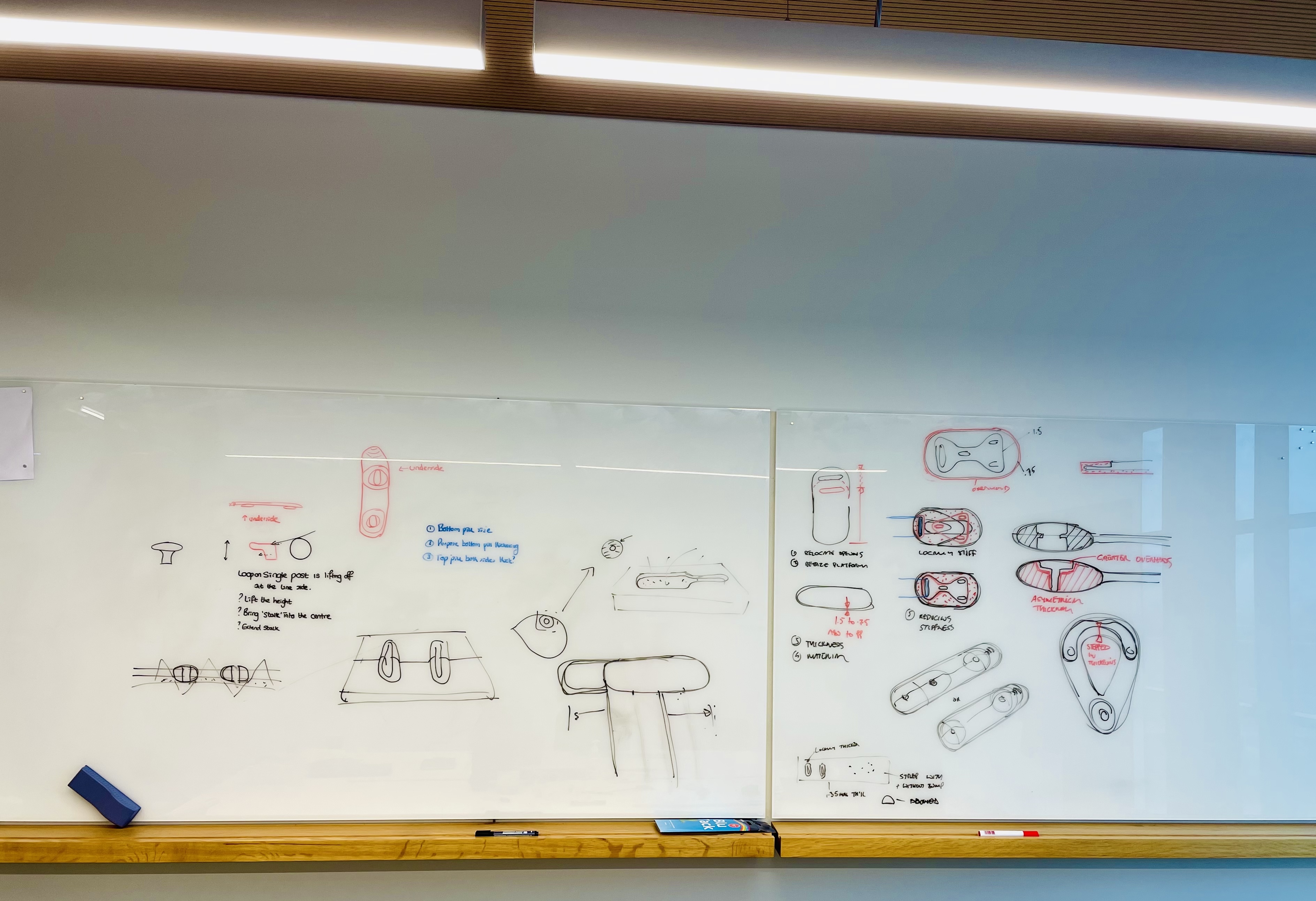
If the infusion tubing could be stabilised independently, we could reduce both accidental pull-out and the micromotion forces transmitted to the catheter tip inside the vein. I sketched ideas between clinical shifts and began looking for support.
Initially, things didn’t go particularly well.
One local NHS organisation explained they weren’t sure how they could help and made it clear that anything I developed would belong to them. A university offered £100,000 in grant funding, which sounded promising until they explained that any intellectual property created would also become theirs.
Neither felt like a fair arrangement for someone trying to solve a problem affecting one in two hospital patients worldwide.
So I turned to someone considerably more formidable. My eighty-year-old Jamaican grandmother. A Windrush pioneer and, in many ways, the queen of taking the scenic route.
She listened patiently, remained reassuringly unimpressed, and lent me £5,000.
With that, Javelo was born.
Growing Pains
Timing is everything.
I founded Javelo just one month before the COVID-19 pandemic began. For much of the following year, I worked on the regional infectious diseases unit caring for patients with COVID.
Clinical medicine rightly took priority, and Javelo’s early progress depended heavily on family, friends and an enormous amount of goodwill. One unexpected consequence of the pandemic, however, was that healthcare became far more receptive to innovation. New funding became available.
I was fortunate to receive support from Innovate UK and, together with investment from Adjuvo, we were able to properly capitalise Javelo and begin building the company in earnest during Spring 2021.
Now What?
Since then, with the support of exceptional mentors, investors and colleagues, Javelo has quietly built a platform of technologies designed to address securement challenges across healthcare and beyond.
We’ve developed three generations of products, refining them alongside healthcare professionals and patients at every stage.
Everything we’ve built has been shaped by the needs of those who deliver care — and those who receive it.
At last, we’re ready to introduce what we’ve been building to the world and begin the next chapter of that journey together.
In the words of someone considerably more famous than me:
Keep moving. Keep growing. Keep learning.
See you at work.
Ash
About Javelo
Javelo is a British medical device company founded by Dr Ashton Barnett-Vanes. Its Chairman is Sir George Buckley, former President, Chairman and CEO of 3M.
Javelo develops reliable, patient-friendly securement solutions that help healthcare providers improve patient safety, comfort and the overall standard of care across both public and private healthcare settings.